
What is an Explosion? | Fundamentals of Industrial Explosions
An explosion is a violent release of energy resulting from a rapid chemical reaction that causes a rapid expansion of gas, resulting in a sudden increase in pressure and temperature. In industrial environments, explosions involving flammable gases, vapours, or dusts typically occur as deflagrations, where a flame front propagates rapidly through a combustible atmosphere.
A strong understanding of explosions is crucial for carrying out a DSEAR risk assessment and hazardous area classification.
What Conditions Are Required for an Explosion?
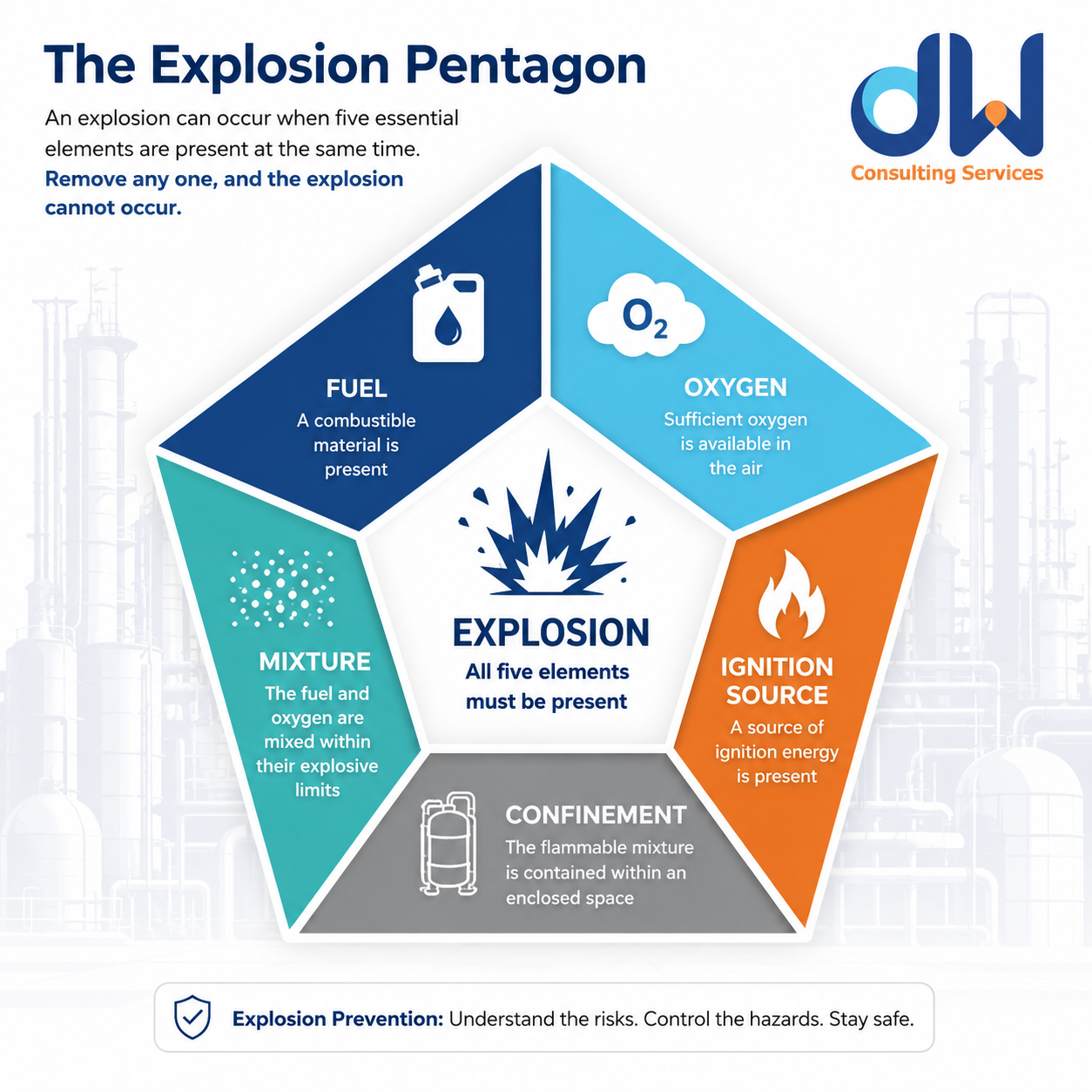
For an explosion to occur, the following elements must be present:
Fuel - this can be a gas, liquid, vapour, or dust
Oxygen - typically the oxygen found in air
Ignition Source - this needs to have sufficient energy to start the combustion reaction
Mixture - the fuel and air mixture needs to be within its flammable or explosive limits
Confinement - this could be provided by a process vessel or building
These elements make up the Explosion Pentagon. This is similar to the Fire Triangle (Fuel, Oxygen, Ignition Source), but is differentiated by the addition of mixing and confinement.
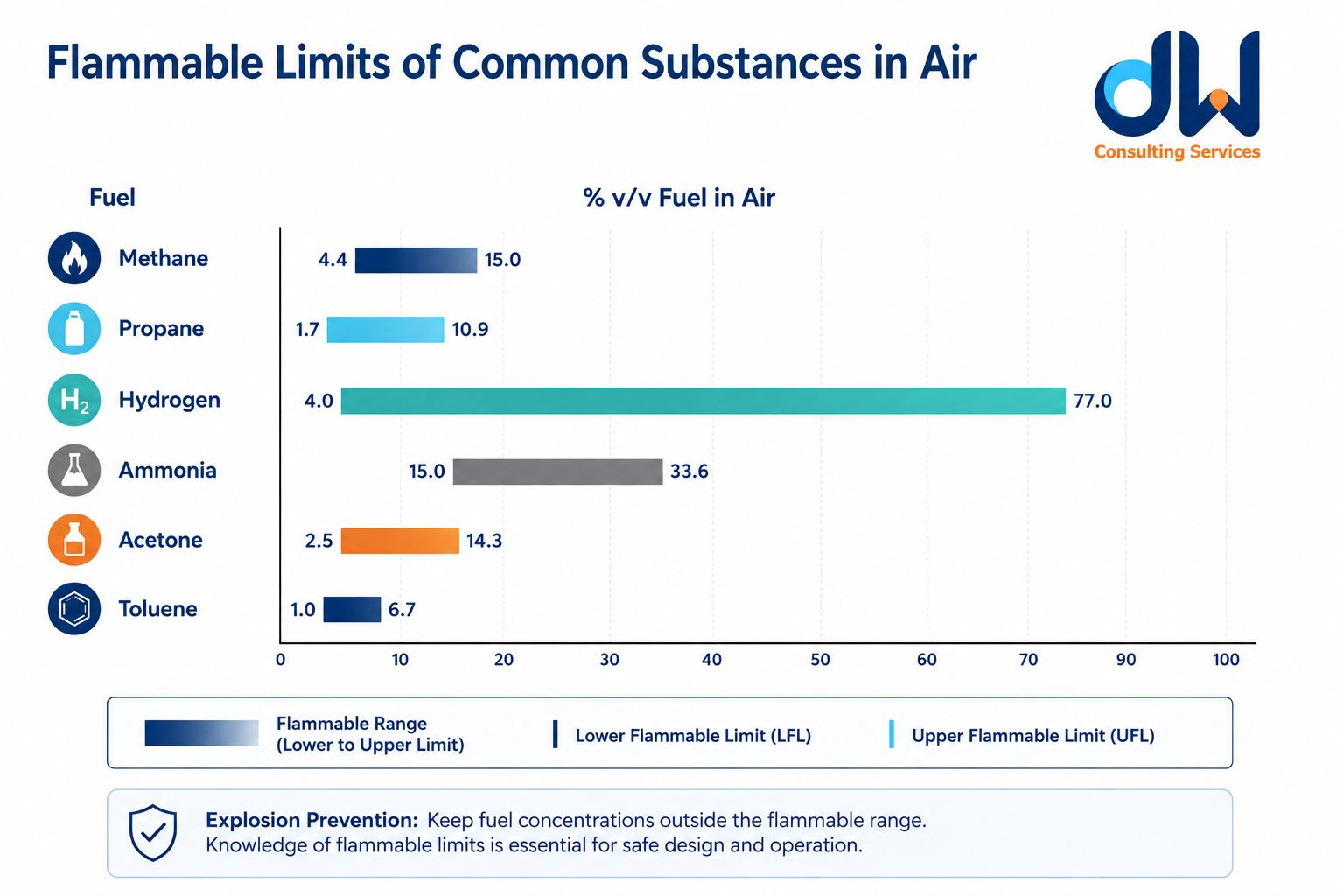
For an explosion to occur, the fuel-air mixture needs to be within an explosive concentration. This is different for each material - for gases and vapours this is known as the flammability limits and measured as a % v/v fuel in air, and for dusts it is known as the Minimum Explosive Concentration (MEC) and measured in grams per cubic metre.
The Lower Flammable Limit (LFL) or MEC is the minimum concentration of fuel and air required for combustion - below this, the mixture is too lean and will not ignite. The Upper Flammable Limit (UFL) is the maximum concentration of fuel and air which can support combustion - above this, the mixture is too rich and will not ignite.
What is a Deflagration Explosion?
A deflagration explosion is a rapid combustion reaction where a flame front propagates through a combustible fuel-oxygen mixture slower than the speed of sound (subsonic). Deflagration is the most common type of explosion that is considered in when we think of vapour cloud explosions (VCEs) or dust explosions in industrial settings, and is a common hazard identified in DSEAR risk assessments. The severity of a deflagration explosion depends on a number of factors, including:
Fuel-Air Mixture Concentration - the closer the mixture is to its stoichiometric ratio (i.e. the perfect amount of fuel and oxygen), the more violent the explosion
Confinement - the degree of confinement typically determines how violent an explosion is
Congestion - congestion can dramatically increase the flame speed and explosion pressures generated, and can result in catastrophic detonation explosions
Initial Process Conditions - parameters such as initial pressure, temperature, and turbulence all impact the severity of an explosion
Explosion Characteristics
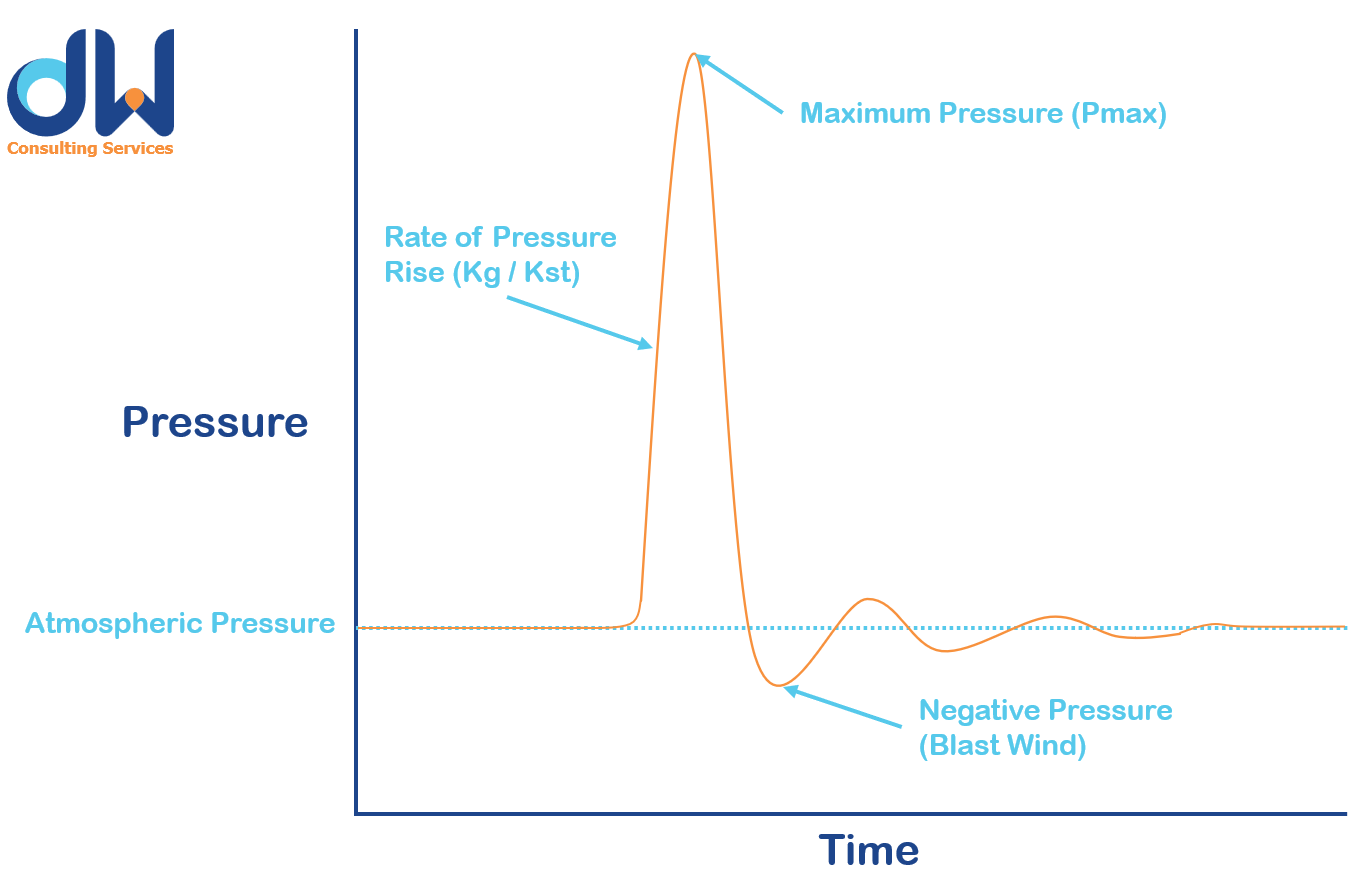
An explosion is characterised by a rapid increase in pressure (known as explosion overpressure), with the rate of pressure rise denoted by Kg and Kst (units of bar m/s ) for gases and dusts respectively. The peak pressure the explosion can reach is known as the maximum explosion pressure (Pmax). These two parameters are commonly referred to as explosion indices, and are crucial for the correct design of explosion protection equipment.
After the rapid increase in pressure (and temperature) caused by the expanding gases, a vacuum is created which can suck objects back towards the explosion. This is known as a blast wind, and can cause additional damage to structures following the initial overpressure. For example, it can cause glass windows to shatter in the opposite direction of the explosion overpressure, and is something that should be considered if investigating an explosion.
Note - Kst is used to denote the rate of pressure rise for dusts as the term originates from German safety standards. Kst stands for “Kubische Staubexplosionskonstante”, with K denoting the constant and “st” denoting the German word “staub”, which means dust.
What is the Difference Between Deflagration and Detonation?
The main difference between deflagration and detonation explosions is the flame speed. Flame speed is a key indicator of how violent an explosion will be - the faster the flame speed, the greater the rate of fuel combustion, resulting in higher explosion overpressures.
A decisive factor in explosion flame speeds is the presence of congestion, which causes explosion generated turbulence. Explosion generated turbulence is a positive feedback mechanism where obstacles (such as pipework blocks or trees and vegetation) cause the flames to stretch and promote more mixing of fuel and reactants. This causes ever-increasing flame speed acceleration, which can eventually become supersonic and result in a detonation explosion with catastrophic effects.
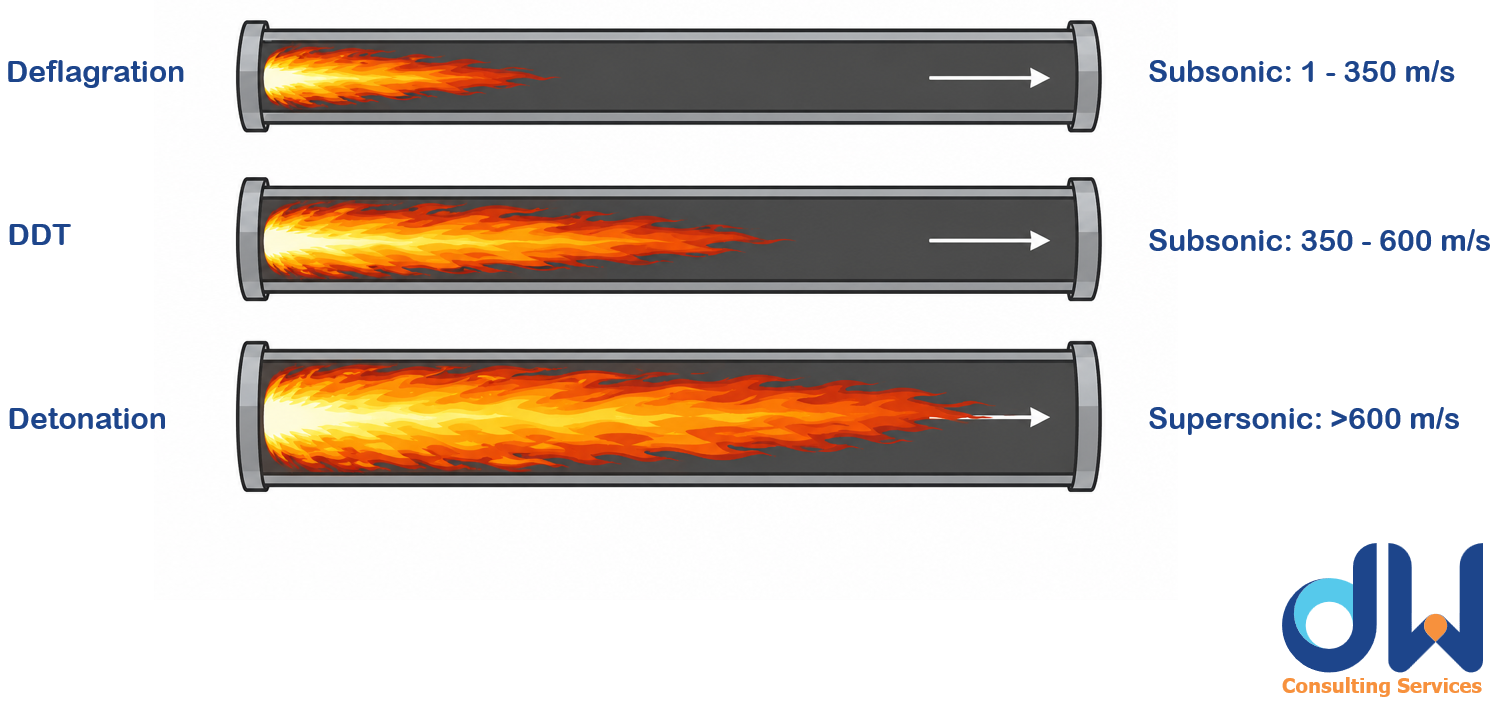
Deflagration explosions typically propagate with flame speeds between 1-350 m/s, with the flame speed depending on a number of parameters, such as the type of fuel, the fuel concentration, and the degree of confinement and congestion. The typical overpressure produced by a deflagration explosion can range from mbarg, up to ~10 barg.
The flame speed region between a typical deflagration and detonation explosion is known as the Deflagration to Detonation Transition (DDT) range, with explosion overpressures in a typical range of 10-20 barg. Once the flame speed is supersonic, a detonation explosion occurs, where flame speeds can be in the range of 1500-2000 m/s and explosion overpressures can reach > 20 barg.
Explosion Flame Speed
Deflagration:
A subsonic flame front travelling relatively slowly through the flammable atmosphere, producing moderate pressure rise.
Deflagration to Detonation Transition (DDT):
The flame accelerates rapidly due to congestion, creating significantly higher pressures.Detonation:
A supersonic combustion wave coupled with a shock front, generating extremely high overpressures and destructive forces.
How to Control Explosion Hazards
The first step in controlling explosion hazards in your workplace is carrying out a hazardous area classification and DSEAR risk assessment to determine where explosive atmospheres could be present, and what safeguards are in place. The main principles for controlling explosion hazards are:
Keeping flammable materials below their lower flammable limit (LFL) - this is usually achieved by dilution ventilation
Removing oxygen from the atmosphere - typically achieved by inerting with nitrogen
Controlling ignition sources - this typically involves installing suitable ATEX equipment, controlling static hazards, and lightning protection
Minimise congestion - consider including breaks and gaps in pipework and equipment layouts to prevent the conditions for flame acceleration and DDT or detonation explosions
Installing explosion protection equipment - this is specialised equipment designed to stop or mitigate the effects of an explosion, and include:
Explosion suppression - a fast-acting system which detects a rise in pressure and deploys an extinguishing agent to stop an explosion
Explosion relief - a weak spot in equipment which is designed to direct an explosion to a safe area and reduce the pressure seen by equipment
Explosion containment - equipment designed to withstand and contain an explosion (typically seen in milling equipment)
Explosion isolation - devices which mitigate propagation of an explosion to connected equipment or areas (e.g. slam-shut isolation valves, float valves, rotary valves, chemical barriers, blast walls)
Remove people from the hazard - restrict access to areas where explosions could occur
Expert Support for Explosion Safety and DSEAR
Our team supports clients across the UK with explosion safety and all aspects of DSEAR compliance, including:
If you need clarity or guidance, get in touch - we’re here to help.