
Hazardous Area Classification | DSEAR and ATEX Experts
Practical, Cost-Effective HAC and Drawings
We provide specialist hazardous area classification (HAC) services across the UK and Europe, helping organisations achieve DSEAR and ATEX compliance.
Using our experience and judgement, we avoid overly conservative zoning, enabling cost-effective ATEX equipment selection while maintaining full DSEAR compliance.
Unlike many providers, we include detailed HAC drawings as standard which can displayed on site to show operators and contractors where ignition sources must be controlled.
The HAC is usually performed at the same time as the DSEAR risk assessment - learn more here.
What is Hazardous Area Classification?
Flammable gases or vapours and combustible dusts can form explosive atmospheres when mixed with or dispersed in air or oxygen. Hazardous area classification (HAC) is used to identify areas where explosive atmospheres may exist (these are known as hazardous zones or areas), and specify an extent in which ignition sources should be controlled. This is a legal requirement and forms part of Regulation 7 of DSEAR.
BS EN 60079-10-1:2021 is the primary standard concerned with the classification of areas where flammable gas or vapour hazards may arise, and BS EN 60079-10-2:2015 is the primary standard concerned with the classification of areas where combustible dust hazards may arise. These standards typically form the basis of a HAC unless another more relevant standard, appropriate industry guidance document, or modelling can be used.
A hazardous zone tells you the likelihood of an explosive atmosphere being present. These are defined as follows:
Zone 0 or 20 is a place where an explosive gas/vapour or dust atmosphere is present continuously or for long periods of time
Zone 1 or 21 is a place where an explosive gas/vapour or dust atmosphere is present periodically or occasionally in normal operation
Zone 2 or 22 is a place where an explosive gas/vapour or dust atmosphere is not likely to occur during normal operation, and would only exist for a short time if it did occur
A zone extent is then calculated or applied to give the zone a defined boundary. For example, a Zone 2 might extend in all directions surrounding a flange or connection in natural gas pipework for 1 m in all directions. Within this area, ignition sources then need to be controlled.
There are many factors which determine the zone classification and extent, including:
Properties of the material, such as the Lower and Upper Explosive Limits (LEL, UEL) for gases/vapours or Minimum Explosible Concentration (MEC) for dusts;
The quantity of material handled
Process conditions
Process containment
Release hole size and geometry
Ventilation and extraction
The outcome of hazardous area classification should be a clear document and set of drawings which clearly shows where explosive atmospheres could be present and how long they are likely to persist, which allows appropriate ignition control measures can be implemented. This will typically involve the procurement and installation of ATEX rated equipment - it’s selection is dependent on the properties of the materials being used and the classified zones. You can learn more about ATEX equipment selection in this article.
Hazardous Area Classification (HAC) Process
Hazardous Area Classification (HAC) can be a complex process. We specialise in providing a HAC document and drawings which are easy to understand, allowing you to effectively control ignition sources where explosive atmospheres could be present.
We have a lot of experience in classifying both existing plants and design stage processes. HAC is a vital input into the design process for new builds and modifications. A good HAC can prevent project delays and overspend.
Below is the a general overview of the HAC process. Our Knowledge Hub also contains a practical guide to HAC.
Step 1: Gather Data
The first step in HAC is to gather information on your site, processes and substances used. This includes:
Material properties (dusts, gases, and vapours)
Process descriptions and operating conditions
Drawings (site layout, PFDs, and/or P&IDs)
Ventilation details
If there is an existing process, we will always conduct a site visit to gather data - there is no substitute for seeing the process in person!
For desktop-based assessments, we will send a tailored request for information to conduct the HAC based on our experience of similar processes. A desktop-based assessment will also require the overall explosion safety to be verified - learn more here.
The HAC is usually performed at the same time as the DSEAR risk assessment - learn more here.
Step 2: Select Applicable Standards and Guidance and Identify Sources of Release
We examine the process and identify where the potential sources of release are. Common sources of release are flanges and connections in pipework, vents, compressor and pump seals, powder tipping points, dust collector exhausts, and inside process equipment.
We have a vast knowledge of standards and industry guidance, allowing us to select the most applicable for your process.
We use recognised industry standards and industry guidance where appropriate for HAC, including:
EN 60079-10-1 for gases and vapours
EN 60079-10-2 for combustible dusts
IGEM/UP/16 and IGEM/SR/25 for natural gas installations
Energy Institute Model Code of Practice Part 15 (EI 15) for flammable fluids
National Fire Protection Association (NFPA) standards
REA guidance for landfill gas and leachate extraction
Step 3: Develop the HAC Document and Drawings
We conduct a detailed assessment of the process to classify the hazardous zones, taking into account material properties, quantity of substances used, process conditions, ventilation, and other considerations.
The HAC document is produced in line with the format given in EN 60079-10-1:2021, which includes:
List of release sources
Grade of release
Process conditions
Ventilation assessment
Zone classification and extent
Minimum ATEX equipment specification required for each zone
Reference to any standards, guidance, and calculations used
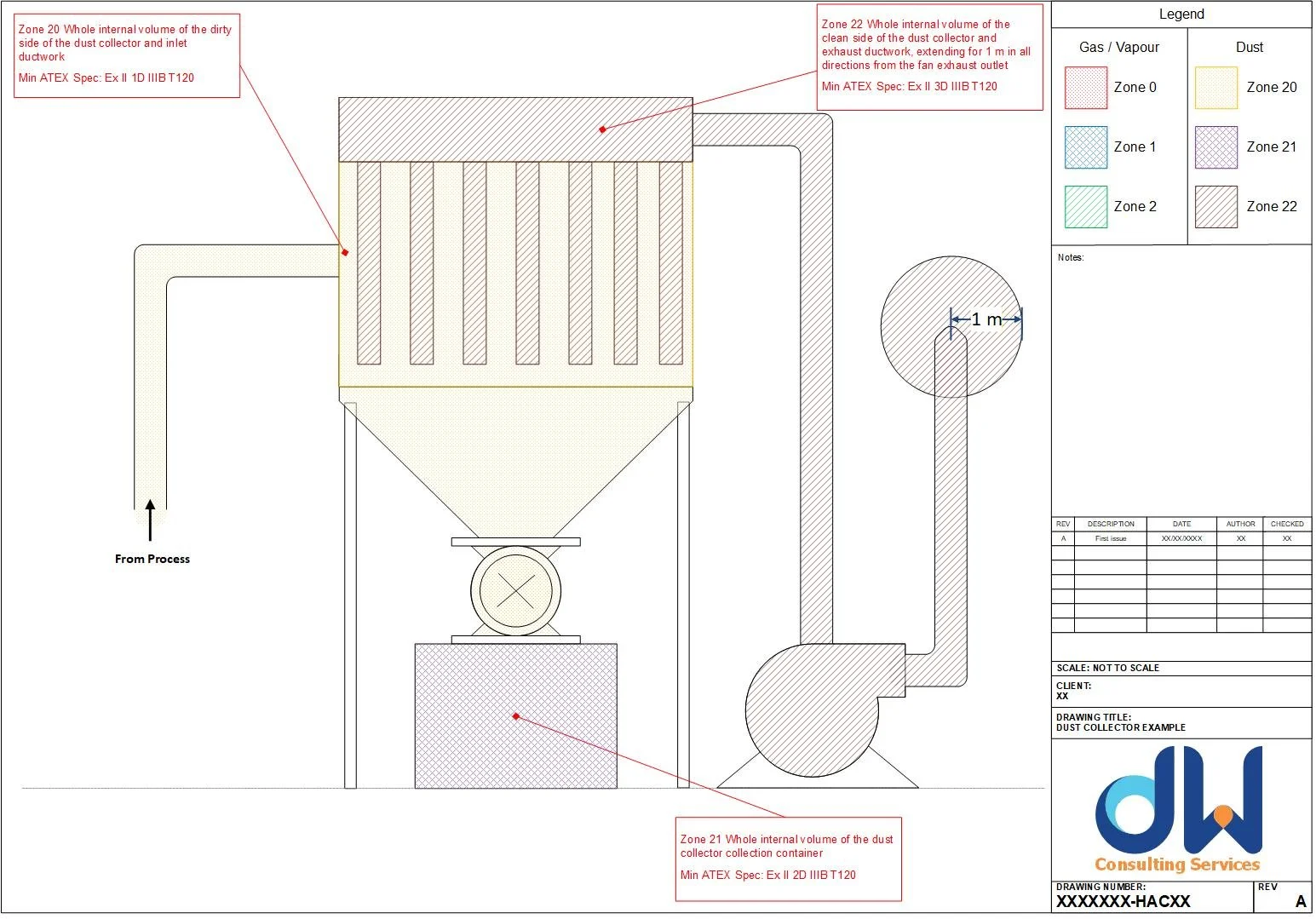
HAC drawings are then produced using either MS Visio or AutoCAD to show the hazardous zones in both plan and elevation view, as required by the DSEAR ACOP.
Step 4: Follow Up Meeting
We offer a follow up call to discuss the findings of your HAC, answer any questions, and advise on the next steps for achieving DSEAR and ATEX compliance.
HAC Deliverables
For each hazardous area classification (HAC) assessment, you will receive the following deliverables:
Report which contains:
Summary of the dangerous substances present and their explosive material properties
HAC Summary - this is a summary of all the hazardous zones classified at your facility, allowing you to view hazardous areas at a glance
Minimum Required ATEX Equipment Specification - for each zone, we state the minimum specification of ATEX equipment required
Full List of Sources of Release - this contains each material and source of release considered, the hazardous zones and extent, as well as stating the ventilation assessment, calculations, standards or guidance used when performing the HAC
Full Set of HAC Drawings - we provide a site plan drawing showing the location of each zone, and an plan and elevation view for each unit operation which has been classified as hazardous. These can be displayed around your facility
Hazardous Area Classification - FAQs
What is hazardous area classification?
Hazardous area classification (HAC) is the process of identifying areas where explosive atmospheres may occur and classifying them into zones based on the likelihood and duration of those atmospheres.
Is hazardous area classification required under DSEAR?
Yes, HAC is a key requirement under DSEAR where dangerous substances are present, forming part of the overall risk assessment process.
What are Zone 0, Zone 1 and Zone 2?
These zones define the likelihood of explosive atmospheres for gases and vapours. Zone 0 is continuous or frequent (e.g. the headspace of a tank containing flammable liquid), Zone 1 is likely during normal operation (e.g. surrounding a process vent tip), and Zone 2 is unlikely but possible under abnormal conditions (e.g. a leak from a flange or pump seal).
What are Zone 20, Zone 21 and Zone 22?
These zones define the likelihood of explosive atmospheres for dusts. Zone 20 is continuous or frequent (e.g. the dirty side of a dust collection unit), Zone 21 is likely during normal operation (e.g. around a sack tipping station), and Zone 22 is unlikely but possible under abnormal conditions (e.g. on the clean side of a filter, to account for failure or leakage).
What is included in hazardous area classification?
A HAC typically includes a list of sources of release (LSR), an assessment of the ventilation, supporting documentation and calculations, and HAC drawings showing the extent of hazardous areas in plan and elevation view.
Are HAC drawings a legal requirement of DSEAR?
Hazardous area classification (HAC) drawings are not a legal requirement of DSEAR, but the DSEAR Approved Code of Practice (ACOP) document states that drawings should be produced to show the zones in both plan and elevation to give a 3D representation of the hazardous zone.